Nusantara Leads the Way for a New Climate Resilience Curriculum
Updated: Aug 11
Something quietly significant happened in Nusantara, Indonesia's new capital city, in 2025. A small team of educators, designers and sustainability practitioners from Alam Santi consulted with teachers in East Kalimantan to design a set of accessible climate education tools. Not abstract lesson plans, not dense policy documents, but real, hands-on classroom resources that a teacher could pick up on a Monday morning and use that same day.

The result is the Climate Resilience Curriculum, developed as part of the Growing Resilience and Ensuring Equality in Nusantara (GREEN) project, a joint initiative of the Nusantara Capital Authority (OIKN), the Asian Development Bank (ADB), and the UK Government through the Urban Resilience Trust Fund. It's now freely available to any school, organisation or educator who wants to use, adapt or build on it.
What's in the curriculum
Designed and produced by Alam Santi, the curriculum references ADB's Climate Change and Education Playbook, which is structured around six pillars: transformative climate literacy, green skills and adaptive behaviours, disaster risk preparedness, low carbon and sustainable school operations, community ownership and behavioural change, and gender equality and social inclusion. It is designed to integrate directly into Indonesia's 2025 National Curriculum, without adding extra work for already-stretched teachers.
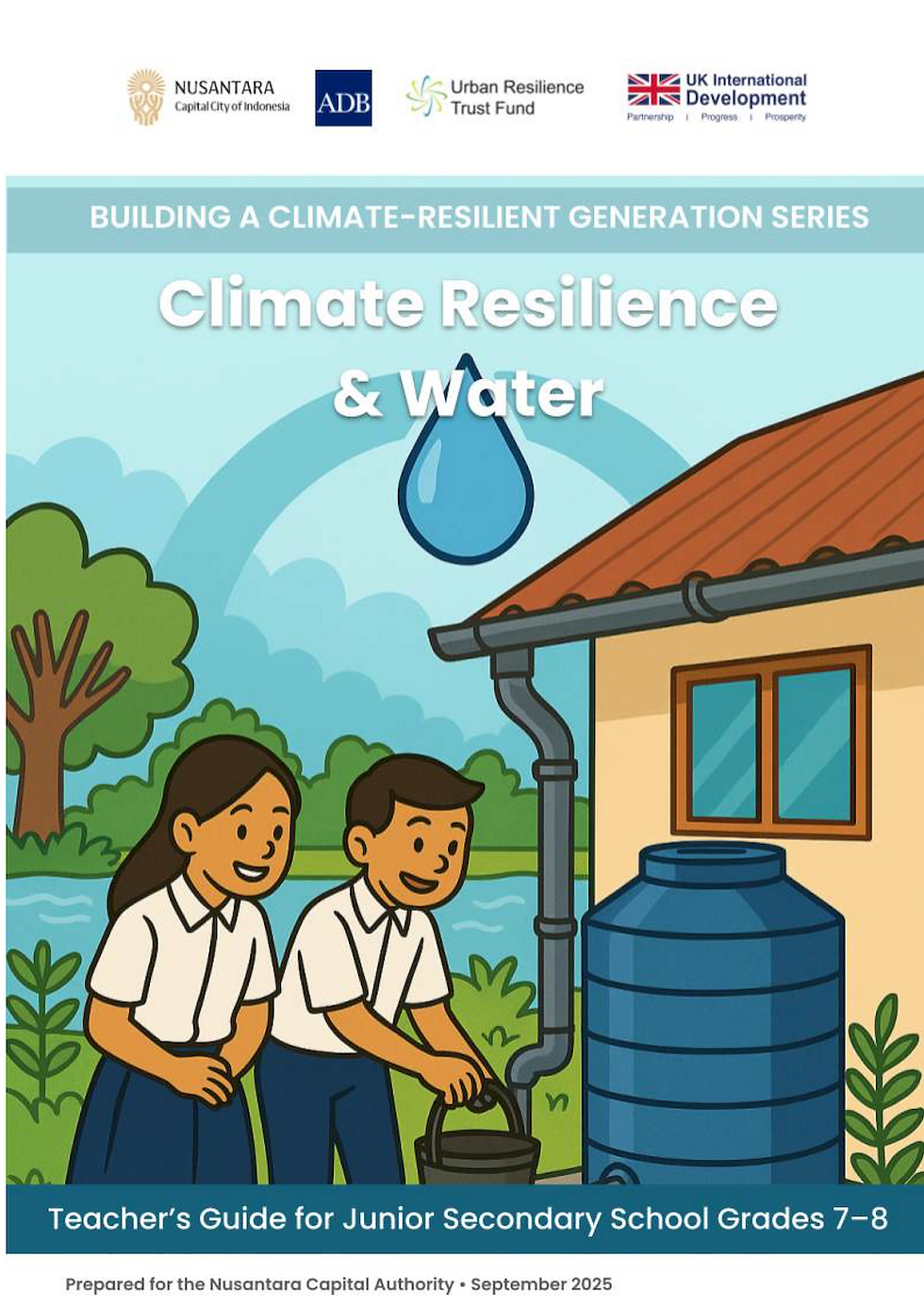
The series includes four teacher handbooks, each targeting a different age group and climate theme related to Nusantara's development plans. Grades 1 to 3 explore waste habits and their link to flooding and pollution, through activities like garbage sorting and a personal commitment poster. Grades 4 to 6 learn to identify local hazards, such as floods, fires, and landslides, through a disaster preparedness crossword and an emergency response bag planning exercise. Grades 7 and 8 dig into water scarcity and flood risk through a water use calculation exercise and a campaign design challenge. Grade 9 focuses on energy, with students conducting energy audits at school and home to identify opportunities for savings.
Alongside the handbooks is a full teacher training presentation, the same deck used to introduce the curriculum to teachers at the two pilot schools, SDN 014 Sepaku and SMPN 20 Penajam Paser Utara. It's built to work as a standalone training tool, so that any school or organisation can run it without outside facilitation.
Why it's free
Indonesia is among the world's most climate-vulnerable nations. Nusantara, built in one of the most biodiverse and at-risk landscapes in Southeast Asia, carries a particular responsibility to model what a resilient, well-educated community looks like. The handbooks were designed from the outset to be low-cost, printable, adaptable and replicable, suitable for urban and rural schools alike, and scalable from a single classroom to a national rollout.
Schools, NGOs, local governments and development organisations are free to adopt the materials directly; adapt them for different hazards, contexts or languages; and use them as a reference model for climate curricula elsewhere in Indonesia and the wider Asia-Pacific region. Materials may be freely copied, adapted and shared, provided that appropriate credit is given to Alam Santi and Ecogames.
The curriculum was commissioned by OIKN and the Asian Development Bank, with funding through the Urban Resilience Trust Fund and UK International Development. Ecogames has developed 15+ original board games, storytelling tools and classroom resources for climate resilience education. Its flagship What's Up Earth? giant board game has been used in schools and community programmes across Indonesia and beyond.
If you use these materials in your school or programme, we would love to hear how it goes. Your feedback shapes the next version, and helps make the case for climate education where it's needed most.